How It Works
Basic Concepts
When developing a Nodejs application that needs to store a tree in a database, the following storage structures are commonly used:
- Adjacency List
- Path Enumeration
- Nested Set Model
- Closure Table
Each of these algorithms has its pros and cons; you should choose the right one based on your actual scenario.
The Nested Set Model is also known as the Left-Right Value model. It is a method for storing tree-structured data, using two fields (commonly called lft and rgt) to represent a node's position in the tree.
In the Nested Set Model, every node's lft value is smaller than the lft values of all its children, and its rgt value is larger than the rgt values of all its children. This way, we can fetch all descendants of a node with a single query—just look for all nodes whose lft and rgt values fall within that range.
The left/right value layout of the Nested Set Model is determined through Depth-First Search (DFS). During the traversal, a lft value is assigned every time we enter a node, and a rgt value is assigned every time we leave a node. Each node's lft and rgt values thus form an interval, and every value within that interval corresponds to a child of that node.
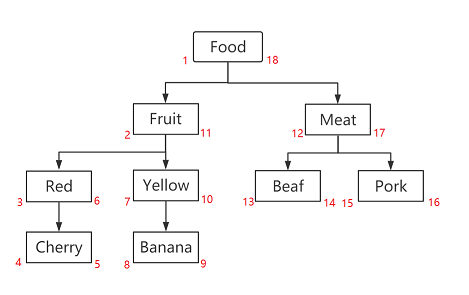
For example, here is a sample Nested Set Model:
| id | leftValue | rightValue | name |
|---|---|---|---|
| 1 | 1 | 14 | root |
| 2 | 2 | 9 | A |
| 3 | 10 | 11 | B |
| 4 | 12 | 13 | C |
| 5 | 3 | 4 | A-1 |
| 6 | 5 | 6 | A-2 |
| 7 | 7 | 8 | A-3 |
This table represents the following tree structure:
- root
- A
- A-1
- A-2
- A-3
- B
- C
- A
Extension
FlexTree is a tree-storage management component built on the Left-Right Value algorithm, developed in Typescript, applicable to any database scenario, and wrapping various easy-to-use APIs.
On top of the Left-Right Value algorithm, FlexTree adds a level field to represent a node's level. With the level field, we can more easily obtain the tree's hierarchical structure, as follows:
| id | level | leftValue | rightValue | name |
|---|---|---|---|---|
| 1 | 0 | 1 | 14 | root |
| 2 | 1 | 2 | 9 | A |
| 3 | 1 | 10 | 11 | B |
| 4 | 1 | 12 | 13 | C |
| 5 | 2 | 3 | 4 | A-1 |
| 6 | 2 | 5 | 6 | A-2 |
| 7 | 2 | 7 | 8 | A-3 |
Solution Comparison
When storing tree-structured data in a database, the most common solutions are:
- Adjacency List
- Path Enumeration
- Closure Table
- Nested Set Model
Compared with Adjacency List
In an Adjacency List, each node has a reference pointing to its parent (pid). As follows:
| id | pid | name |
|---|---|---|
| 1 | NULL | root |
| 2 | 1 | A |
| 3 | 1 | B |
| 4 | 1 | C |
| 5 | 2 | A-1 |
| 6 | 2 | A-2 |
| 7 | 2 | A-3 |
This approach is simple, intuitive, and the easiest to understand and use, but queries require recursive lookup, which performs poorly.
For example, to implement the following:
- Query all descendants of a node
- Query all ancestors of a node
- Move a subtree under another node
- Delete a node and its descendant subtree
None of these can be done with a simple 1-N SQL statements; they require recursive queries at the application layer—the deeper the tree, the worse the performance.
Performance & Metrics Comparison
In the "SQL request count" column below, values are labeled in
FlexTree / comparisonorder;Nmeans it grows linearly with the depth or size of the tree, and—means this item does not involve SQL request count.
| Dimension | FlexTree (Nested Set Model) | Adjacency List | SQL requests (FlexTree / Adjacency List) |
|---|---|---|---|
| Query descendants | Single SQL, range query on left/right values, efficient | Requires recursive query, slower as depth grows | 1 / N (recursive) |
| Query ancestors | Single SQL, range query on left/right values, efficient | Requires recursive query, slower as depth grows | 1 / N (recursive) |
| Query direct children | Single SQL | Single SQL (filter by pid) | 1 / 1 |
| Query parent | Single SQL | Single SQL (filter by pid) | 1 / 1 |
| Add node | Needs to update left/right values of related nodes (affects 1-N rows) | Just INSERT 1 row | 2 (update + insert) / 1 |
| Delete subtree | Needs to update left/right values (affects 1-N rows) | Must recursively fetch descendants first, then delete | 2 (delete + shrink) / N (recursive) |
| Move subtree | Needs to reorder left/right values (affects 1-N rows) | Just update pid (1 row) | 2 / 1 |
| Storage structure | Single table + leftValue/rightValue/level | Single table + pid | — |
| Recursion required | No | Yes (when querying) | — |
| Ordered tree | Naturally ordered | Requires an extra order field | — |
| Level depth | Bounded by integer range (rarely hit in practice) | Unlimited | — |
Compared with Path Enumeration
Because of the recursive performance issues of the Adjacency List, the Path Enumeration structure was introduced. Path Enumeration builds on the Adjacency List by adding a path field to store the node's path, as follows:
| id | path | name |
|---|---|---|
| 1 | /root | root |
| 2 | /root/A | A |
| 3 | /root/B | B |
| 4 | /root/C | C |
| 5 | /root/A/A-1 | A-1 |
| 6 | /root/A/A-2 | A-2 |
| 7 | /root/A/A-3 | A-3 |
The advantage of this scheme is that querying all descendants of a node only requires querying the path field—no recursive query needed. However, it also has downsides when the tree has many levels:
- Query operations are mostly
likeoperations on thepathstring, which perform poorly. - The path can become very long, limiting the tree's depth; an ordinary
VARCHARmay not be enough, requiringTEXT. - Choosing which field to concatenate into
pathis an issue.- If
nameis used as thepathfield, duplicate names, special characters, or changes in thenamevalue can makepathnon-unique or abnormal. Therefore, the field used aspathshould ideally be unique, short, rarely changing, and free of special characters. - If
id(pk) is used to composepath, sincepkis unique and relatively stable, it's a better fit for thepathfield. But if theidfield is auuidtype, thepathbecomes very long and query efficiency drops accordingly.
- If
- Moving a subtree under another node is also relatively simple. For example, to move /root/A/A-2 to become a child of /root/B, run the following
SQL:
sql
UPDATE tree_table
SET path = REPLACE(path, '/root/A/A-2', '/root/B/A-2')
WHERE path LIKE '/root/A/A-2%';- A Path Enumeration tree table is unordered; to support an ordered tree, an extra
orderfield is needed to maintain node order, as follows:
| id | path | order | name |
|---|---|---|---|
| 1 | /root | 1 | root |
| 2 | /root/A | 2 | A |
| 3 | /root/A/A-1 | 3 | A-1 |
| 4 | /root/A/A-2 | 4 | A-2 |
| 5 | /root/A/A-3 | 5 | A-3 |
| 6 | /root/B | 6 | B |
| 7 | /root/C | 7 | C |
Once order turns the tree into an ordered tree, the logic to maintain the order field becomes more complex.
In short, we have to weigh the choice of the path field and consider the length and query efficiency of path. If the field composing path (such as name) may have duplicates, special characters, or changes, it is not suitable as a path field.
Performance & Metrics Comparison
| Dimension | FlexTree (Nested Set Model) | Path Enumeration | SQL requests (FlexTree / Path Enumeration) |
|---|---|---|---|
| Query descendants | Range query on left/right values, index-friendly, efficient | LIKE prefix match on path, average performance | 1 / 1 |
| Query ancestors | Range query on left/right values, efficient | Needs to parse / split the path string | 1 / 1 |
| Add node | Needs to update left/right values (affects 1-N rows) | INSERT + compute path by concatenation | 2 (update + insert) / 1 |
| Delete subtree | Needs to update left/right values (affects 1-N rows) | Delete in one pass via path LIKE | 2 (delete + shrink) / 1 |
| Move subtree | Needs to reorder left/right values (affects 1-N rows) | REPLACE all paths of the subtree | 2 / 1 |
| Storage overhead | Integer fields, low overhead | path string, grows long with depth, may need TEXT | — |
| Ordered tree | Naturally ordered | Requires an extra order field | — |
| Field choice | Only needs a stable id | path field needs trade-offs (duplicates, special characters, changes) | — |
| Level depth | Bounded by integer range | Bounded by path field length | — |
Compared with Closure Table
The Closure Table structure needs two tables to represent a tree: one stores node information, and the other stores the relationships between nodes. As follows:
- Node table
| id | name |
|---|---|
| 1 | root |
| 2 | A |
| 3 | B |
| 4 | C |
| 5 | A-1 |
| 6 | A-2 |
| 7 | A-3 |
- Relation table
| ancestor | descendant | depth |
|---|---|---|
| 1 | 1 | 0 |
| 1 | 2 | 1 |
| 1 | 3 | 1 |
| 1 | 4 | 1 |
| 1 | 5 | 2 |
| 1 | 6 | 2 |
| 1 | 7 | 2 |
| 2 | 2 | 0 |
| 2 | 5 | 1 |
| 2 | 6 | 1 |
| 2 | 7 | 1 |
| 3 | 3 | 0 |
| 4 | 4 | 0 |
| 5 | 5 | 0 |
| 6 | 6 | 0 |
| 7 | 7 | 0 |
- As shown above, to query all descendants of a node, each node must record all its ancestors as well as each node's depth. This requires more storage space and higher maintenance cost.
Performance & Metrics Comparison
| Dimension | FlexTree (Nested Set Model) | Closure Table | SQL requests (FlexTree / Closure Table) |
|---|---|---|---|
| Number of tables | Single table | Two tables (node table + relation table) | — |
| Query descendants | Single SQL, range query | Single SQL, query the relation table | 1 / 1 |
| Query ancestors | Single SQL, range query | Single SQL, query the relation table | 1 / 1 |
| Add node | Needs to update left/right values (affects 1-N rows) | Needs to insert relation records with all ancestors (more rows at deeper levels) | 2 (update + insert) / N (N = depth) |
| Delete subtree | Needs to update left/right values (affects 1-N rows) | Needs to delete all relation records of the subtree | 2 (delete + shrink) / N |
| Move subtree | Needs to reorder left/right values (affects 1-N rows) | Needs to rebuild all relations between the subtree and ancestors | 2 / N |
| Storage overhead | Lower (single table, integer fields) | Higher (relation table grows roughly O(n²)) | — |
| Maintenance cost | Medium | High (must keep two tables in sync) | — |