Async Event Iterator
Overview
When on/onAny is called without specifying a valid listener function, it returns an async event iterator FastEventIterator, allowing you to subscribe to events via for await (const messages of emitter.on(<event>)).
typescript
import { FastEvent } from "@fastevent/core";

const emitter = new FastEvent();
// Emit an event
emitter.emit("user/login", { userId: 123 });
// Subscribe to an event
for await (const message of emitter.on("user/login")) {
    console.log("User login:", message.payload);
}
Guide
Pull Mode
Unlike subscribing to events via a regular listener, consuming event messages with an async event iterator is a classic pull pattern.
- Regular event subscription is a push model: the event emitter (the producer) pushes event messages to subscribers (the consumers).
- Consuming event messages with an async event iterator is a pull model: subscribers actively pull messages themselves.
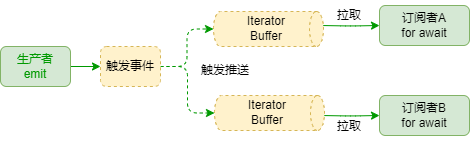
Buffer
When returning an async iterator (i.e. in pull mode), a FastEventIterator is created for each subscriber, and a FIFO message buffer is automatically created internally.
Event consumers pull messages from the buffer via for await.
The default message buffer parameters are as follows:
ts
{
    overflow: "slide",
    size: 20,
    maxExpandSize: 100,
    expandOverflow
}- The default buffer size is
size=20. - When the buffer overflows, the default
overflow=expandmeans the buffer is automatically expanded up tomaxExpandSize=100. - Once expanded to
maxExpandSize=100, the oldest message is removed according toexpandOverflow=slide.
Message Lifetime
After a message is placed into the buffer, you can configure the lifetime parameter to specify the maximum lifetime of a message in the buffer. When it is exceeded, the message is automatically dropped.
ts
const messages = emitter.on("count", {
    iterator: {
        // Maximum lifetime of 1 minute; dropped automatically when exceeded
        lifetime: 60 * 1000,
    },
});
Unsubscribing
An async iterator subscription can be unsubscribed in the following ways:
- Cancel by passing in an
AbortSignal
ts
const abortController = new AbortController();
const messages = emitter.on("count", {
    iterator: {
        signal: abortController.signal,
    },
});
setTimeout(() => {
    abortController.abort();
});
for await (const message of messages) {
    console.log(message);
}- Automatically unsubscribed when the
for awaititeration ends
During the for await iteration, executing return, break, or throwing an error will automatically unsubscribe.
ts
const abortController = new AbortController();
const messages = emitter.on("count");

for await (const message of messages) {
    console.log(message);
    // 1. Exit the async iteration by throwing an error
    throw new Error("Trigger an error");
    // 2. Break the loop
    break;
    // 3. Return
    return;
}
// Automatically unsubscribed after exiting the iteration
Configuration Parameters
ts
export interface FastEventIteratorOptions<T = FastEventMessage> {
    /** Default buffer size (default: 20) */
    size?: number;
    /** How large the buffer may expand to before it stops expanding (default: 100) */
    maxExpandSize?: number;
    /** Overflow policy after expanding to the maximum size (default: 'slide') */
    expandOverflow?: Omit<FastQueueOverflows, "expand">;
    /** Overflow policy (default: 'slide') */
    overflow?: FastQueueOverflows;
    /** Message lifetime (in milliseconds); 0 means disabled (default: 0) */
    lifetime?: number;
    /** Triggered when a new message arrives */
    onPush?: (newMessage: T, messages: [T, number][]) => void;
    /** Triggered when a message is popped; you can sort the message queue here */
    onPop?: (messages: [T, number][], hasNew: boolean) => [T, number] | undefined;
    /** Triggered when a message is dropped */
    onDrop?: (message: T) => void;
    /** Error handler; returning true continues iteration, false stops iteration */
    onError?: (error: Error) => boolean | Promise<boolean>;
    /** Signal used to cancel the iteration */
    signal?: AbortSignal;
}